













Contents
- Start with how your customers actually pay
- The three places a payment app can live
- How payment pricing generally works
- Big tickets, deposits and holds
- Surcharges, convenience fees and cash discounts
- Chargebacks: protect yourself before the job
- Payouts and bookkeeping
- Field realities: test in the worst conditions
- Questions to ask every vendor
- Run a real test before you switch
- The short version
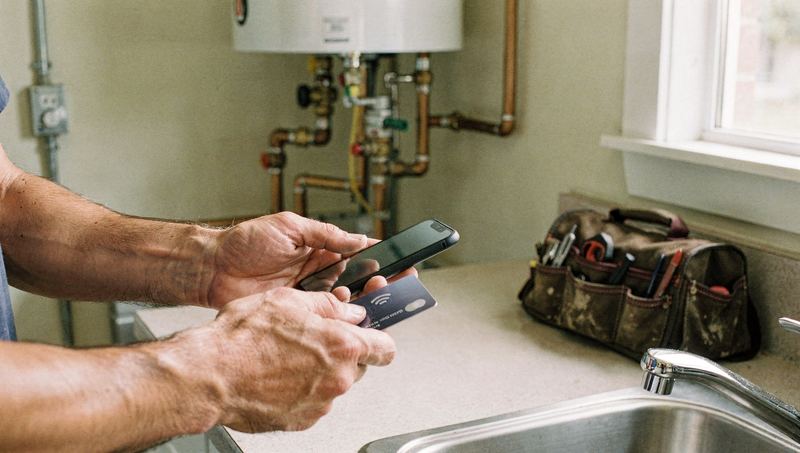
You just finished swapping a water heater. The homeowner wants to pay by card, it's 6:40 p.m., and the basement has one bar of signal. What happens next depends on the payment app you picked. A good one takes the payment in seconds, sends a receipt, puts the money in your bank and matches it to the invoice. A bad one leaves you chasing a check next week.
This guide walks through how to choose a payment app for a plumbing, HVAC, electrical, roofing, landscaping or cleaning business: how pricing models work, where fees hide, and what to test before you move every job over.
Start with how your customers actually pay
Before you look at any app, write down how money comes in today. Payment needs differ a lot by trade, and the app that suits a cleaning company can be a poor fit for a roofer.
| Business | Typical payment moment | What the app must handle |
|---|---|---|
| Emergency plumbing or drain work | On site, right after the fix | Tap or card reader, text-to-pay link, fast receipts, weak signal |
| HVAC repair and replacement | On site for repairs; deposit plus balance for replacements | Deposits, partial payments, a financing option, larger tickets |
| Electrical service and panel upgrades | On site for service; deposit and progress payments for bigger jobs | Split payments, invoices tied to permit and inspection milestones |
| Roofing | Deposit, then balance after the install; sometimes insurance funds | Big-ticket card payments, bank transfer (ACH), check logging, progress billing |
| Landscaping maintenance | Monthly or per visit on a route | Recurring billing, autopay, card on file, batch charges |
| Residential cleaning | After each visit, often while the client is out | Card on file, automatic charge, tips, easy refunds |
| Commercial accounts | Monthly invoice on terms | ACH, check, PO fields, statements |
Circle the rows that describe your business. Your must-haves come from there, not from a vendor's feature page.
The three places a payment app can live
You'll find payments in three kinds of software. Decide where payments should live first, then pick the provider.
| Option | How it works | Good fit when | Watch out for |
|---|---|---|---|
| Standalone payment app | A general card app with its own reader and invoices | You're solo or small and don't use job software yet | Double entry: jobs in one place, payments in another |
| Payments built into field service software | The tech takes payment from the job or invoice in their app | You already schedule and invoice in that software | You may be tied to its processor and rates, so switching one means switching both |
| Payments through accounting software | Customers pay invoices from a link and payments post to your books | Most of your work is invoiced, not collected on site | Weaker on-site tools for techs |
There's no single right answer. The rule is to avoid a setup where a tech collects in one app, the office invoices in another and your bookkeeper matches them by hand at month end. For the bigger picture, see all-in-one platform or best-of-breed tools.
How payment pricing generally works
Processors price in a handful of ways. Names vary, but most plans are one of these or a mix. Pricing and plan names change often, so use this as a map of what to ask, not a price list.
- Flat rate. One percentage per transaction, often plus a small fixed fee, sometimes different for tapped, keyed-in and online payments. Easy to understand and easy to compare.
- Interchange-plus. You pay the card networks' underlying cost (interchange, which varies by card type) plus a stated markup. Harder to read, but the markup is visible, which helps at higher volumes.
- Tiered. Transactions are sorted into buckets like "qualified" and "non-qualified" at different rates. Ask exactly what puts a payment in each bucket, because that drives your real cost.
- Subscription. A monthly fee in exchange for lower per-transaction pricing.
- Bundled with software. Some field service tools include or require their own payments. Ask whether you can bring your own processor and what changes if you do.
Then there are the fees that rarely appear on a pricing page: chargeback fees, instant payout fees, bank transfer fees, monthly minimums, PCI compliance fees, statement fees, hardware costs and early termination fees. Ask about each one by name.
Work out your effective rate
The only number that compares providers fairly is your effective rate:
Effective rate = total fees paid in a month ÷ total payments processed that month
Ask each vendor to price your last three months of real transactions and tell you the effective rate. If they won't, that tells you something.
Keyed-in cards (typed into the app instead of tapped or inserted) often cost more and carry more fraud risk. If your techs key in most payments today, fixing that habit can matter as much as the provider you choose.
Big tickets, deposits and holds
This is where trades differ most from retail shops. A drain clearing is routine. A full roof or a new heat pump is a much larger payment, and processors may review or hold unusually large payments, especially on newer accounts.
Before your first big job on a new account, ask:
- Is there a per-transaction or monthly volume limit, and how do I raise it?
- What triggers a review or a hold on funds, and how long do holds usually last?
- Can I take a deposit now and charge the balance later against the same card?
- How do I take progress payments on a multi-day job?
- Can customers pay large balances by bank transfer, and what does that cost me?
- If a customer uses third-party financing, how does that money reach me and how does it show on the invoice?
Tell your processor your typical and largest ticket sizes when you sign up. An account set up for small service calls can get flagged the first time a five-figure payment comes through.
Surcharges, convenience fees and cash discounts
Many owners want to pass card costs on to customers. Rules on surcharging, convenience fees and cash discount programs differ by card network and by state, and they change. Before you add any fee to a customer's bill, confirm the current rules with your processor and talk to your accountant or attorney. If you're not sure, build card costs into your prices instead. Our guide to credit card processing fees goes deeper.
Chargebacks: protect yourself before the job
A chargeback is when a customer disputes a payment with their card issuer. In home services the usual story is "the work wasn't done as described" or "I didn't agree to that amount." You win disputes with records you collect during the job, not after.
Ask each vendor how disputes work: how you're notified, how long you have to respond, whether you can upload photos and signatures from the job, and whether there's a fee even when you win.
Payouts and bookkeeping
A payment isn't finished until the money is in your bank and matched to the invoice. Ask:
- How long until payments land in my bank, and is it different on weekends and holidays?
- Is there an instant or same-day payout option, and what does it cost?
- Are deposits paid gross (fees billed monthly) or net (fees taken out of each deposit)? Net deposits are harder to match to invoices.
- Does the app sync to my accounting software, with fees, tips and refunds as separate lines?
Your bookkeeper will thank you for a clean sync. More in bookkeeping basics for contractors.
Field realities: test in the worst conditions
Payment demos happen in bright offices with good Wi-Fi. Your techs work in crawl spaces, attics, rooftops and backyards.
- Weak signal. Ask whether the app can store a payment offline and process it later, and what happens if that card declines once you're back in range.
- Tap to pay on a phone. Many providers now let a phone accept contactless cards without a separate reader. Check which phones are supported and whether your techs' phones qualify.
- Readers. If you need one, how is it charged, and what happens when it's lost or dropped off a ladder?
- Tech permissions. Can you stop techs from issuing refunds or changing prices without approval?
- Tips. Cleaning crews and some residential teams get tipped. Can the customer add a tip, and does it report cleanly for payroll?
Questions to ask every vendor
Get the answers in writing. Pricing pages change, and a sales rep's promise only helps you if it's in your agreement.
Run a real test before you switch
Once you have a favorite, test it with your own card before you move every job:
- Take a $1 payment by tap, then by keying in the card, then by sending a payment link.
- Refund one and see how long the refund takes to show.
- Take a deposit, then charge the balance.
- Save a card on file and charge it the next day.
- Read every receipt as your customer would. Is your business name clear? Is the job address there? Is there a way to contact you?
- Wait for the payout and check the amount against what you expected.
- Check that everything landed correctly in your accounting software.
When you switch, don't close the old account on day one. Refunds and disputes on older payments may still run through it, so ask your old provider how they handle those after you leave. Our guide to switching software without losing a week covers the rest of the move.
The short version
Start from how your customers pay, decide where payments should live, compare providers on effective rate rather than headline rate, ask about limits and holds before your first big job, collect dispute-proof records on every job, and test in a real basement before you commit. If you want to see how we think about collecting on site and online as part of the whole job, Zome's payments page lays it out. Whatever you choose, pick the app your techs will actually use at 7 p.m. in a wet basement.