







Contents
- How homeowners actually find a service company
- The foundation: fix these before you buy ads
- Get found in local search
- Paid channels: when and how to use them
- Win the job: turn leads into booked work
- Keep customers: your cheapest marketing
- Get seen around town
- Social media and content
- Set a budget that fits your business
- A simple 90-day plan
- Measure what matters
- Mistakes that waste the most money
Home service marketing isn't one thing. It's everything that happens between a homeowner noticing a problem and that same homeowner calling you again five years later. Most owners try one channel at a time, a round of ads here and some posts there, and judge each in isolation. This guide lays out the whole system in the order that makes sense for a small crew, so each dollar and hour builds on the last.
How homeowners actually find a service company
Start with the customer's situation, because it changes how they choose.
| Type of need | Examples | What the customer does | What wins the job |
|---|---|---|---|
| Urgent | Burst pipe, no cooling in a heat wave, garage door stuck shut, storm damage | Searches on a phone and calls the first company that looks credible | Showing up in local results, answering the phone, a clear arrival time |
| Planned | New roof, panel upgrade, bathroom remodel, exterior paint | Researches, asks neighbors and gets a few quotes over days or weeks | Reviews, photos of similar work, a clear written estimate, follow-up |
| Recurring | House cleaning, lawn care, pest control | Chooses once, then stays while the service is reliable | Easy booking, reliability, good communication, fair pricing |
| Maintenance | Tune-ups, water heater flushes, gutter cleaning | Often forgets until something reminds them | Reminders, memberships, being the name they already know |
Most businesses get a mix. An HVAC company gets no-cool calls in July and replacement decisions in October. Your marketing needs to cover each type of need you want more of. For more on how the decision gets made, see How homeowners choose a contractor today.
The foundation: fix these before you buy ads
Advertising sends people to your business. If the business looks weak when they arrive, you pay for the click and lose the job anyway. Get these five right first.
- Google Business Profile. Accurate categories, the services you offer, the area you serve, correct hours, real photos and a steady flow of reviews. For many local searches, this is the first thing a homeowner sees. Google Business Profile tips covers every field.
- A website that turns visits into calls. Tap-to-call at the top of every mobile page, a page for each main service, proof you're licensed and insured, and photos of your real crew. How to build a contractor website that books jobs walks through it.
- Reviews. Recent, steady and answered. Ask every customer, fairly. Ask for reviews without filtering the truth shows how.
- Answering every lead. Calls answered or returned fast, missed calls texted back and web forms answered the same day. No ad can fix an unanswered phone.
- A customer list. Names, contact details, job history and whether each person agreed to hear from you. Every other channel feeds this list, and it's the asset you'll use for years.
Get found in local search
Most home service searches are local: "plumber near me", "AC repair" plus a town name, "roof leak repair". Whether you show up comes down to three things.
- Relevance. Your profile and website say clearly what you do. A page about water heater repair and replacement in your town is a better match for that search than a single page that says "plumbing services".
- Distance. You can't move your shop, but you can make your service area clear and build pages for the towns where you really work, with real jobs from each one.
- Prominence. Reviews, mentions on other local sites, consistent listings and a website other people link to. This builds over months, not days.
Keep your business name, address and phone number identical everywhere they appear online. Mismatched listings confuse customers and search engines alike. The details are in SEO for home service businesses and The home service SEO bible.
Paid channels: when and how to use them
Once the foundation is solid, paid channels can add volume quickly. Each works differently, so match it to the kind of job you want.
| Channel | How you pay, in general | Best for | Watch out for |
|---|---|---|---|
| Pay-per-lead search ads, such as Google's Local Services Ads | Per lead, where your trade and area are eligible | Urgent and common jobs | Lead quality varies; eligibility and rules change |
| Search ads | Per click | Specific high-value services you choose | Costs add up fast without tight targeting and a good landing page |
| Lead marketplaces | Per lead or by subscription, depending on the site | Filling gaps in the schedule | Leads may go to several companies at once; you rent the customer rather than own the relationship |
| Social media ads | Per view or per click | Planned and seasonal work, local awareness | Weak for emergencies; ads need regular refreshing |
| Direct mail and door hangers | Printing and postage | Streets around current jobs, homes that fit a service | Hard to measure without a tracking number or code |
Pricing models and rules on every one of these platforms change often, so check each one's current terms before you commit a budget.
Rules that apply to any paid channel:
- Start with one channel and one service. Pick the service with the best profit and steady demand, not everything at once.
- Track it separately. Give each channel its own tracking phone number or tagged form so you know what it produced.
- Judge it on booked jobs, not clicks or leads. Cost per booked job = what you spent on the channel ÷ jobs booked from it.
- Give it enough time and budget to learn something, then keep it, fix it or cut it.
Local Services Ads vs Google Ads and Angi, Thumbtack, Yelp and Google: where paid leads come from go into each option.
Win the job: turn leads into booked work
Marketing doesn't stop when the phone rings. A lot of money leaks out between the lead and the booking.
- Respond fast. Someone with water on the floor calls the next company if you don't pick up. When you're on a roof or under a house, have a person, an answering service or at least an automatic text back.
- Use a simple phone script. Greet them, get their name, understand the problem, confirm the address, offer a time, explain how pricing works (a service call fee or a free estimate) and tell them what happens next.
- Quote clearly, with options. A written estimate with two or three options lets the customer choose between your options instead of comparing you with the next company on price alone. See Good, better, best pricing.
- Show proof. Reviews, photos of similar jobs, license and insurance details and a written warranty.
- Follow up on every open estimate. A simple rhythm: a text the next day to check they got it, a call around day three to answer questions, a short note around day seven and a last check-in around day fourteen. Then stop.
Keep customers: your cheapest marketing
A customer who already trusts you costs far less to win again than a stranger from an ad, yet keeping in touch is often the first thing to slip when the schedule is full.
- Ask for a review after every job. Reviews keep working long after the job is done.
- Send reminders based on the last job. Tune-ups, water heater flushes, gutter cleaning, pest treatments and deck resealing all have a natural next date.
- Offer a maintenance membership where it fits. How to build a maintenance membership program covers design and pricing.
- Stay in touch, with permission. A useful seasonal email or text, not a weekly sales blast. Email marketing for home service businesses has examples.
- Make referrals easy. Ask, give people a simple way to pass your name on, and thank them properly.
Customer retention for home service businesses goes further.
Get seen around town
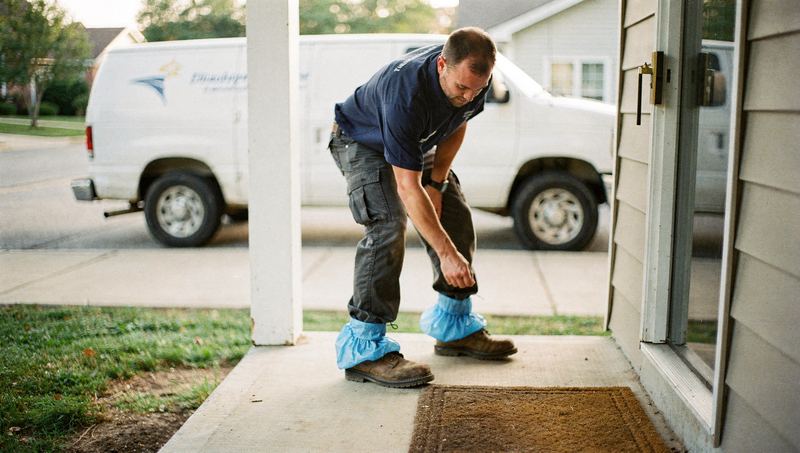
Home service work is local and visible. A clean, clearly lettered truck in a driveway is seen by the whole street. Add yard signs (with the homeowner's permission and within HOA and city rules), door hangers on nearby homes after each job ("We were working on your street today") and local events the families you serve actually attend. Branding for home service businesses covers trucks, uniforms and signs.
Social media and content
You don't need to go viral. You need to look active, real and good at what you do when someone checks you out before calling. Post before-and-after photos of real jobs (with permission, and nothing that identifies the home), short seasonal tips and introductions to your team, and reuse each good job on your Google profile, social accounts and website gallery. Social media for contractors and Instagram for contractors go deeper.
Set a budget that fits your business
Skip rules of thumb built on someone else's revenue. Work backward from what a job is worth to you.
- Gross profit per job = average ticket − direct costs (labor and materials for the job)
- What you'll spend to win a job = gross profit per job × the share you're willing to spend on getting it
- Monthly budget = extra jobs you want each month × what you'll spend to win a job
A hypothetical example: say your average ticket is $450 and direct costs are $225, leaving $225 of gross profit. If you're willing to spend a third of that to win a new customer, you can spend about $75 per booked job. Want 20 extra jobs a month? That's a $1,500 monthly budget.
Now test each channel against that limit. If search ads bring leads at $40 each and you book one in three, your cost per booked job is $120, well over your $75. You'd need to book more of those leads, improve the landing page or advertise a higher-value service. Remember too that a customer who comes back for years is worth more than their first ticket.
A simple 90-day plan
| Month | Focus | Actions |
|---|---|---|
| 1 | Foundation | Finish your Google profile, fix the mobile call button and service pages, start review requests after every job, set up missed-call text back |
| 2 | One growth channel | Pick one paid or local channel for your most profitable service, track it with its own number, follow up every open estimate |
| 3 | Keep and measure | Start service reminders or a membership offer, send one useful message to past customers, review cost per booked job and decide what stays |
The marketing checklist and How to write a marketing plan for your home service business help turn this into a plan you'll stick to. If you want more options to choose from, 50 marketing ideas for home service businesses has plenty.
Measure what matters
Every month, track leads, booked jobs and revenue by source, cost per booked job for each paid channel, new reviews and your rating trend, and repeat customers as a share of all jobs. Ask every new customer "How did you hear about us?" even if you use tracking numbers, and write the answer down. Marketing analytics: which calls came from where explains the setup.
Mistakes that waste the most money
- Running ads to a website that's hard to use on a phone
- Judging channels by clicks instead of booked jobs
- Trying five channels at once with no tracking
- Sending estimates and never following up
- Ignoring past customers while paying to find new ones
- Stopping all marketing in the busy season, then scrambling when it gets slow
Want to know where your own foundation stands before you spend anything? The free AI report from Zome checks your Google profile, website and reviews and shows who ranks above you and why.