




Contents
Every field app looks good in a sales demo. The screens are clean, the Wi-Fi is fast and nobody's hands are wet. The real test is a basement with no signal, a customer asking "so what's this going to cost?" and a tech who wants to finish the paperwork before the next call.
This guide walks through a plumbing job step by step, shows what the app has to do at each point, and ends with a two-week pilot plan and the questions to ask before you sign anything.
Follow one job from start to finish
Picture a routine call: a water heater leaking from the bottom, in a house you've been to once before. Here's what your tech needs from the app at each step.
| Step | What the tech needs | What to check in the app |
|---|---|---|
| Before leaving | Address, problem notes, gate or lockbox codes, likely parts | Is everything from the call or booking on the job, or does the tech have to phone the office? |
| On the way | Directions and an on-my-way text | Does one tap send the customer an arrival text? |
| Arrival | History at this address | Can the tech see last visit's notes, photos and the water heater's age and model? |
| Diagnosis | Photos, video, notes, readings | Can photos and video attach to the job from inside the app? |
| Options | Prices the customer can compare | Can the tech build good, better and best options from the price book in a few taps? |
| Approval | A signature and written authorization | Is the signature captured on the estimate, with date and time? |
| The work | Parts used and time on the job | Do parts flow onto the invoice without retyping? |
| Wrap-up | Invoice, payment, review request, next reminder | Can the tech get paid before leaving and set a reminder for next year's flush? |
If any row makes your tech call the office or write something down to type in later, that's a cost you'll pay on every job.
The must-haves
It works with no signal
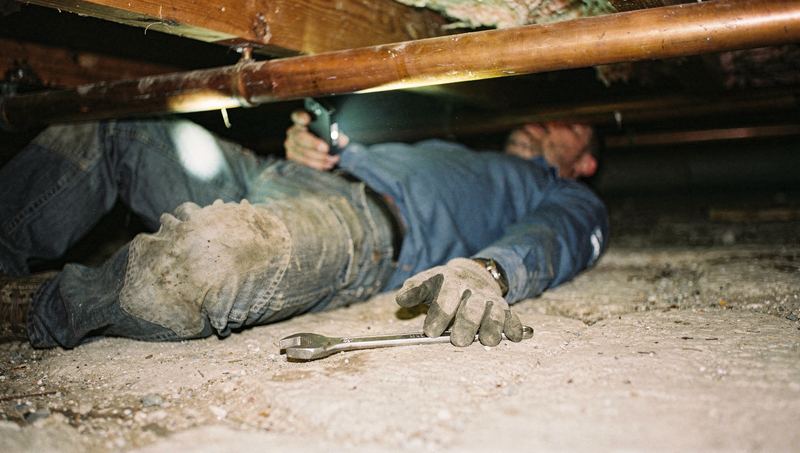
Basements, crawl spaces, mechanical rooms and rural properties are where plumbers spend their day, and they're where phones lose signal.
Check what the app can do offline: open the day's jobs, add notes and photos, build an estimate, capture a signature and record a payment for later processing. Then check what happens when the signal returns. Does everything sync, or does something get lost? Test this in a real dead zone, not by switching to airplane mode for ten seconds.
History tied to the property, not just the customer
Plumbing history belongs to the building. The landlord pays, the tenant calls, the house sells. Check whether the app keeps history at the address and can hold equipment records: a photo of the water heater's data plate, its install date, the fuel type, and notes like "PRV set at install" or "cleanout behind the washer."
Photos and video on the job
Photos protect you and sell the work. A sewer camera clip showing roots in the line explains a repair better than any description.
- Can the tech attach photos and short videos directly to the job?
- Are they time-stamped?
- Can they be added to the estimate or sent to the customer?
- Are there storage limits, and what happens when you hit them?
If your camera inspection system has its own app, check whether you can easily move clips onto the job record.
A price book on the screen
Techs present prices more confidently when they're choosing from a list, not inventing numbers in the driveway. Check that your price book can be loaded with your real tasks, that techs can present options side by side, and that office price changes reach every phone. See how to build a price book your team will actually use and good, better, best pricing.
Signatures and change approvals
Plumbing work changes once walls open. The shutoff valve crumbles, the drain line is worse than it looked. Check that the app can capture a signed approval before work starts, add a change to the job and capture a second signature, and attach both to the job record. Put your terms on the estimate the customer signs.
Payment before the truck leaves
- Can the tech take a card on site, by card reader or tap-to-pay on the phone?
- Can they text a payment link if the homeowner isn't there?
- Can they take a deposit on a larger job, like a repipe?
- Does a financing application start from the job, if you offer financing?
Processing fees vary by provider and payment type, so read the terms. See how to choose a payment app and credit card processing fees, explained.
Forms and checklists
A checklist catches the step that gets skipped on a busy day. A water heater install checklist might cover the expansion tank, the relief valve discharge line, venting, gas or electrical connections, the permit number and final photos.
If you test backflow devices, check whether your water authority requires its own report form and whether the app's forms can match it. Check that forms can include required fields and photos and that completed forms attach to the job.
Parts and job status
At a minimum, the parts used on a job should land on the invoice without retyping. If you want truck-level inventory, check how the app handles restocking. Job status matters too: when a tech taps "arrived" or "done," the office should see it without calling, and the right customer texts should go out.
Nice to have, not first
- GPS location. Useful for dispatch. Tell your team how it's used, and check local rules on tracking employees.
- Sizing tools. Pipe sizing and water heater sizing calculators live in many separate apps. Always check results against local code and the manufacturer's instructions.
- Manufacturer apps. Handy for warranty registration and product lookups.
- Chat with the office. Nice, but a phone call works fine for a small shop.
One system or several apps?
| Approach | Good for | Watch out for |
|---|---|---|
| The mobile app of a field service management system | Crews of two or more with an office person; one record from call to payment | Cost per user, setup time, features you pay for and never use |
| Several separate apps (notes, photos, invoicing, card reader, calendar) | Solo plumbers keeping costs down | Retyping, lost photos, nothing connected at the office |
| Specialty apps alongside either one | Camera inspection, leak detection, manufacturer tools | Getting their files onto the job record |
A solo plumber can do well with a few simple apps and good habits. Once a second truck or an office person joins, a shared system usually saves more time than it costs. For the bigger picture, see what is field service management software? and all-in-one platform or best-of-breed tools?.
Usability tests that matter on a plumbing job
Features on a comparison chart mean little if the app is hard to use under a sink. Run these tests yourself.
Run a two-week pilot
- Pick yourself and one tech who's willing but honest.
- Load your twenty most common price book items, your job types and one checklist.
- Use it on real jobs for two weeks, and keep your old system running in the background.
- Track four things: taps from arrival to paid invoice, sync problems, minutes of paperwork per job, and questions customers asked about the estimate or invoice.
- Sit down with the tech at the end and ask what they'd miss and what drove them crazy.
- Decide. If the answer is "no," you've lost two weeks, not a year.
When you're ready to switch, see how to switch software without losing a week.
Questions to ask before you sign
Get the answers in writing. Pricing and features change, so rely on the current terms in front of you rather than anything you read months ago. See how field service software is priced.
Zome works on the other end of the job: getting found and winning the call. Its app page shows how it approaches that for owners on the road, with new requests, customer replies and reviews in one place.