








Contents
- How Google chooses which plumbers to show
- Step 1: Set up your Google Business Profile properly
- Step 2: Build one page for each service you want more of
- Step 3: Add town pages only when you have something real to say
- Step 4: Earn reviews that describe the work
- Step 5: Make your details match across the web
- Step 6: Get the website basics right
- Step 7: Earn local links and mentions
- Step 8: Win the emergency searches
- Step 9: Track what's working
- Mistakes that hold plumbers back
- A 90-day plan
When a water heater lets go at 6 a.m., nobody browses. They grab their phone, search "plumber near me" or "emergency plumber [town]" and call one of the first businesses they see. Local SEO is the work that puts your company on that short list, both in the map results and in the regular results below them. This is the plumber-specific version: what to set up, what to write, what to avoid and what to track.
How Google chooses which plumbers to show
Google says its local results are based mainly on three things:
- Relevance: how well your profile and website match what was searched. "Tankless water heater install" is a different search from "drain cleaning".
- Distance: how far you are from the person searching, or from the place named in the search.
- Prominence: how well known and trusted your business is, judged from things like reviews, links and mentions across the web.
You can't move your shop closer to every customer, so the work goes into relevance and prominence. Also, map rankings change depending on where the searcher is standing. You might rank first in your own town and not at all ten miles out. That's normal, and it's why service pages, town pages and reviews from across your area matter.
Step 1: Set up your Google Business Profile properly
Your Google Business Profile is the heart of local SEO for a plumber. Go through every field.
For the services list, cover what you really do. For many plumbers that includes drain cleaning, sewer line repair and replacement, camera inspection, hydro-jetting, water heater repair and replacement, tankless water heaters, leak detection, repiping, gas line work (where you're licensed for it), fixture installation, garbage disposals, sump pumps, water treatment, backflow testing (where you're certified) and emergency plumbing.
For more detail, use the Google Business Profile checklist, the Google Business Profile tips guide and How to write your Google Business Profile description.
Two warnings. Adding keywords to your business name, like "[Name] Plumbing Best Emergency Plumber 24/7", goes against Google's guidelines and can get your profile suspended. So can listing a virtual office or someone else's address to appear in a town where you don't have a real location. Grow into new towns with service pages, town pages and reviews instead.
Step 2: Build one page for each service you want more of
A "Services" page with twenty bullet points can't rank for twenty different searches. Give each service that matters to you its own page.
| Service page | How people might describe the problem | What the page should cover |
|---|---|---|
| Drain cleaning | "kitchen sink backing up", "drain clogged", "drain cleaning near me" | Common causes, cabling vs hydro-jetting, camera inspection, what to do until you arrive |
| Water heater replacement | "no hot water", "water heater leaking", "water heater replacement cost" | Tank vs tankless, sizes, typical timeline, permits where required, haul-away, price range |
| Sewer line repair | "sewer backup", "roots in sewer line", "sewer camera inspection" | Warning signs, camera inspection, repair and replacement options, what digging involves |
| Leak detection | "hidden water leak", "water bill suddenly high", "water under floor" | How you find leaks, what it costs, help with insurance paperwork |
| Repiping | "repipe house", "galvanized pipe replacement", "low water pressure" | Materials, how long it takes, staying at home during the work, wall repair |
| Emergency plumbing | "emergency plumber", "burst pipe", "24 hour plumber" | Hours you really answer, after-hours fees, how to shut off the water |
Every service page should have:
- A headline naming the service and your main area, like "Water heater replacement in [Town] and nearby"
- Signs the customer needs this service
- How you do the work, step by step
- Pricing: a range, a starting price or a clear explanation of how you price it
- Questions customers ask, with short answers
- Reviews that mention this service, and photos of real jobs
- The towns you serve
- A tap-to-call button and a booking button near the top
The service page checklist walks through each part in detail.
Write title tags with a simple pattern: Service in Town, State | Business name. For example, "Water Heater Replacement in [Town], [ST] | [Business]". Keep each title unique.
Step 3: Add town pages only when you have something real to say
Pages that repeat the same text with a different town name swapped in are what Google calls doorway pages. They can hurt more than they help.
A useful town page includes things only a plumber working there would know. Use only what's true from your own experience:
- The kinds of homes and plumbing you tend to see there, such as older homes with galvanized supply lines or newer builds with PEX
- Local water conditions, like hard water and what it does to water heaters and fixtures, if that applies
- Permit requirements for common jobs in that town or county, and whether you handle them
- Recent jobs you've done there, described without addresses, with photos
- Reviews from customers in that town
- Response times you can actually meet there
Start with the three to five towns you most want more work in, and make each page genuinely different.
Step 4: Earn reviews that describe the work
Reviews help your prominence, and they also do your selling. A review that mentions the actual job, like a leak found behind a shower wall and fixed the same day, persuades a stranger more than two words of praise.
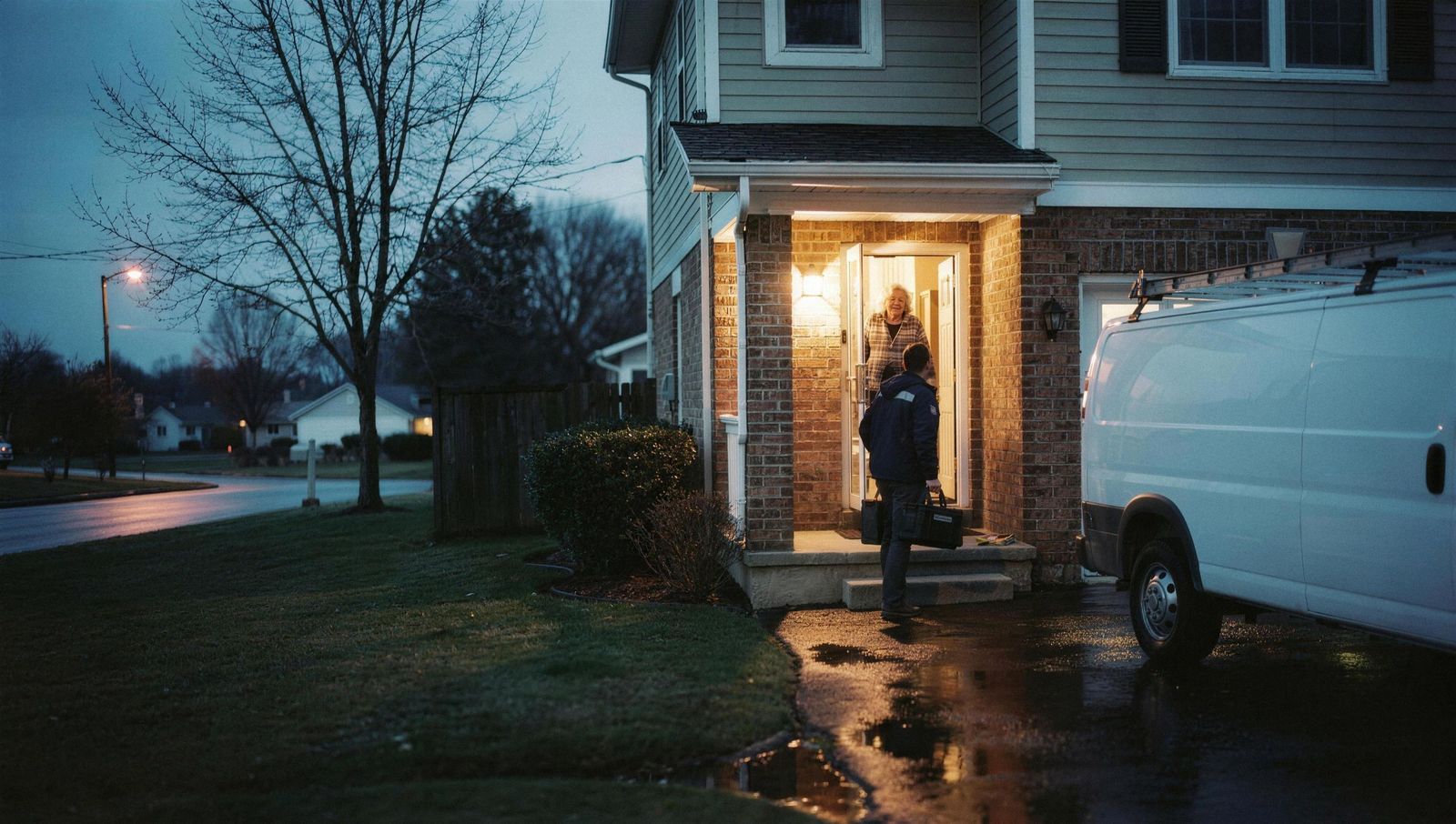
Script (at the truck): "Thanks for having us. If you're happy with how we handled the leak, a Google review really helps us. I'll text you the link now. If you mention what we fixed, it helps other people with the same problem find us."
A few rules:
- Ask every customer, the same day, with a direct link by text.
- Never offer discounts, gifts or credits in exchange for reviews. Google's policies prohibit it.
- Don't only ask the customers you think are happy.
- Reply to every review, briefly and specifically.
Reply template (positive): "Thanks, [Name]. Glad we could get your water heater swapped before the weekend. [Your name], [Company]"
Reply template (negative): "[Name], I'm sorry this wasn't the experience you expected. I'd like to understand what happened and make it right. Please call me directly at [number]. [Your name], [Company]"
Keep negative replies calm and take the details offline. How to ask for reviews honestly covers the full process.
Step 5: Make your details match across the web
Your business shows up in far more places than Google: map apps, directories, review sites and lead sites. When the name, phone number or address differs from one to the next, it creates doubt for search engines and customers alike, and an old number sends a real customer to a dead end.
Claim and complete your listings on:
- Apple Business Connect (Apple Maps)
- Bing Places
- Yelp
- Nextdoor
- The Better Business Bureau
- Lead sites where you keep a profile, such as Angi and Thumbtack
- Your local chamber of commerce and plumbing trade associations
- Manufacturer installer directories, if you're a certified installer for a water heater or fixture brand
Use exactly the same business name, phone number and website everywhere, and keep a spreadsheet of every listing and its login. If you've moved or changed numbers, fix the old listings. For how the paid lead sites compare, see Angi, Thumbtack, Yelp and Google: where paid leads come from.
Step 6: Get the website basics right
Step 7: Earn local links and mentions
Links and mentions from real local organizations show you're an established local business.
- Sponsor a youth sports team, school event or charity drive that lists sponsors on its website.
- Offer a local news outlet or neighborhood newsletter a timely tip, like protecting pipes before a hard freeze or what to do when a basement floods.
- Partner with real estate agents, home inspectors, remodelers and restoration companies who keep lists of recommended pros.
- Join your local chamber of commerce and trade association.
- Offer to speak at a homeowners' association meeting about water heaters or sewer lines.
Never buy links or join link-swapping schemes. They're against Google's guidelines and can do lasting damage.
Step 8: Win the emergency searches
Emergency searches are high stakes for the customer and often valuable for you. Get these right:
- Be honest about hours. Mark yourself open 24 hours only if a person really answers at 2 a.m. A customer who calls at night and gets voicemail may leave a review about it.
- Build an emergency page. Say what counts as an emergency, your after-hours fee, how to shut off the main water, and what to do if they smell gas: leave the house and call the gas utility or 911.
- Answer or text back. Missed calls should get an instant text so the customer doesn't move on to the next plumber.
- Consider Local Services Ads. They can appear above the map for urgent searches. See Local Services Ads vs Google Ads for how they work and what to watch.
Step 9: Track what's working
Check these once a month:
- Calls and website clicks from your Google Business Profile, from its performance report
- Calls and form requests from your website, by page
- Rankings for your main searches, checked from several points across your service area, since results change by location
- New reviews this month and your replies
- Most important: booked jobs by source. Ask every new customer "How did you find us?" and record the answer
Mistakes that hold plumbers back
- Keyword-stuffed business names
- Fake or virtual addresses
- More than one profile for the same business
- Copy-paste town pages
- Paying for reviews, or only asking happy customers
- Forgetting to update holiday hours
- Stock photos instead of real jobs
- A website that hides the phone number
A 90-day plan
| Month | Focus |
|---|---|
| Month 1 | Complete your Google Business Profile, fix your top listings, start asking for a review after every job |
| Month 2 | Build pages for your five most valuable services and an emergency page, and set up tracking |
| Month 3 | Build pages for your top three towns, start local link outreach, run your first monthly review of results |
For a deeper dive, read the plumber SEO guide and the Google Maps ranking guide.
If you'd rather not do all of this yourself, see how Zome handles local SEO for trades. Or start with the free AI report, which shows who outranks you on Google and what to fix first.